
These delicious, sweet dessert alternatives that we call raw treats are taking front row in almost all café’s and health food stores. Now before you jump to conclusions, it certainly depends on how you define your relationship between ‘healthy’ and ‘food’ – but let me tell you where I’m coming from.
First of all, raw treats are a dessert made with whole food, unrefined ingredients like dried fruits, coconut oil, nuts, agave or rice malt syrup (I know what you’re thinking, how would these treats not be good for us). They require little to no preparation and are either baked in the oven or frozen in the freezer. Most recipes just require you to throw all the ingredients into the food processor and voila!… this is my type of “cooking” ;).
But regardless of the ingredients and the desert itself stating that its unrefined, organic or natural, it’s the dried fruits and syrups that people aren’t taking into consideration when eating these foods – at the end of the day it’s still SUGAR!
If we look at it by reading a recipe that says “add 12 medjool dates” well this means you have just added 192g of sugar (This figure has been calculated using FoodWorks). Now if that doesn’t make your eyebrows raise, I don’t know what will. People are claiming that raw treats are better for us for really only two reasons. The first one being the nutritional value because compare a raw treat and a Mars Bar, the raw treat contains things like nuts and dried fruits which yes, nutritionally they are good for us. However, it is the second point that may prove healthy and raw treats shouldn’t be in the same sentence. A raw treat contains unrefined sugars and something like a Mars Bar contains refined sugars.
So, what’s the difference? Unrefined sugars retain all of sugar’s natural nutrients like magnesium, calcium, iron, etc. These nutrients not only nourish our bodies but takes us longer to break down giving us (somewhat) sustained energy. On the other hand, refined sugar contains none of these nutrients and are basically empty calories. Our bodies breakdown refined sugar almost immediately and so zero energy is obtained. Consequently, causing our blood sugar levels to sky rocket, otherwise known as a sugar rush.
In Addition to this, the moment when that raw goodness enters your mouth and just melts away is usually caused by the binding ingredient; coconut oil. Most recipes that I have witnessed have up to half a cup or more of coconut oil, and let’s not forget that coconut oil is a saturated fat. Saturated fats aka: bad fats unfortunately block our arteries and these bad boys are found in most animal bi-products (butter, cheese, yoghurt). Saturated fats have proven to raise your ‘bad’ (LDL) cholesterol, therefore putting your body at higher risk for heart disease.
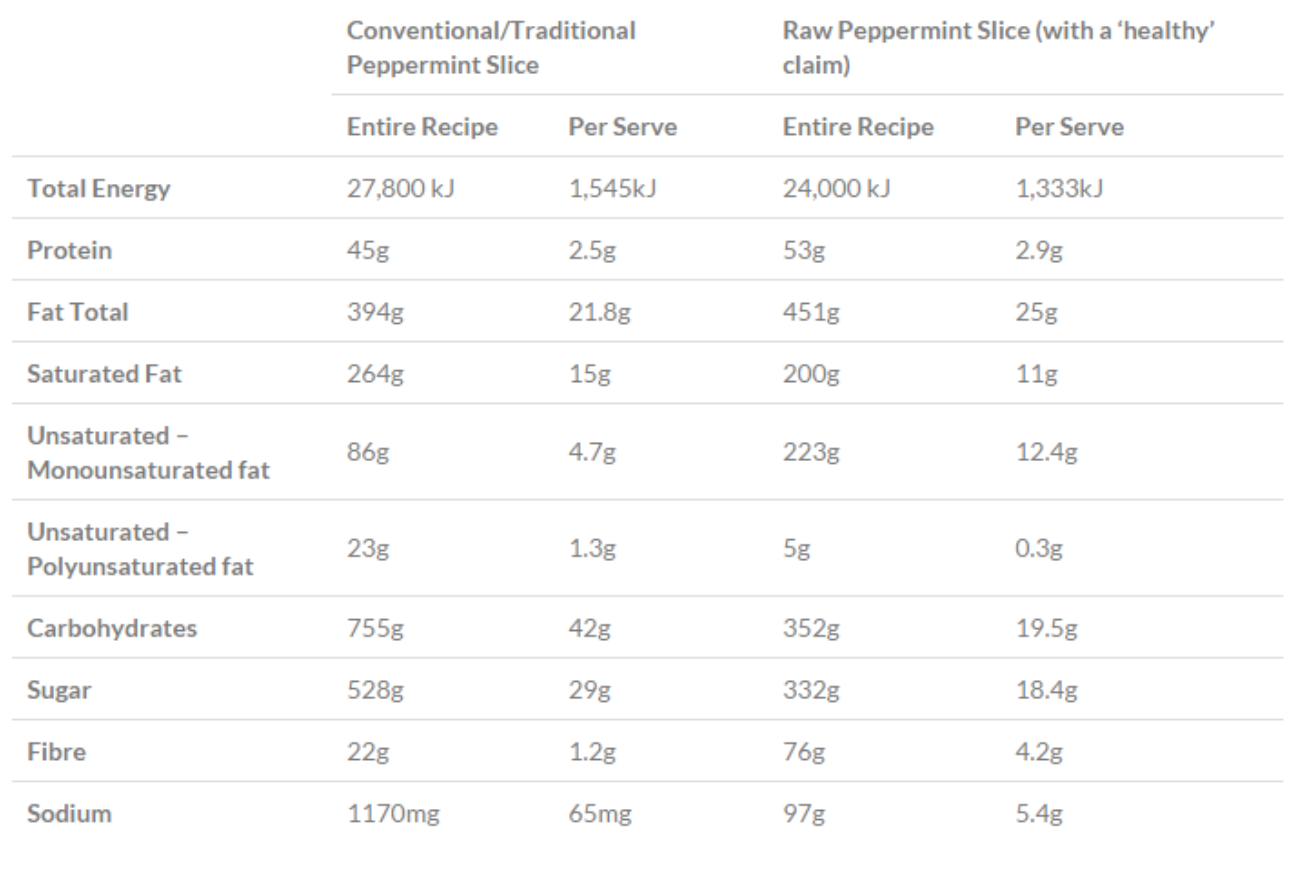
Now that we have cleared that I am not writing off raw treats because yes, they have less sodium, and more fibre and nutrients. All I am saying is they can sometimes contain just as much calories and saturated fat as chocolate bars or cookies, so please, have them in moderation.
If you’re someone who is trying to lose weight and are substituting raw treats instead of your fave choccy bar or ice-cream that’s okay but research the serving size and how many calories are in your raw treat, because you may be better off sticking to the choccy. (This advice is based on a calorie deficit meal plan).
Below shows a table sourced from synergyhelath.net.au, comparing a raw treat to a conventional treat. I have put this here so you can make up your own mind.
At the end of the day:
- Treats are treats
- It’s all about discipline.
- Have all sweets and/or treats in moderation (this includes serving size).
- It may NOT be broken down the same way, but it IS being store the same way.
- Just because it says it’s organic or natural unfortunately doesn’t give us a free pass to ‘go ham’ on the dessert.
 Talking with Taylah
Leave a comment